

If you’ve ever managed an ISO 14001 or ISO 50001 system using spreadsheets, shared drives, and the occasional panic-fuelled document hunt before an audit, you’ll understand exactly why we built ISO Align.
We’ve been there. We’ve lived through the chaos of scattered Word documents, version control nightmares, and the dreaded “Where did we put that evidence?” moments that make audit season feel like a trial by fire rather than a structured review of your management system.
The Problem We Kept Seeing Everywhere
During our years of consulting on ISO 14001 and ISO 50001 implementations, we noticed the same pattern repeating across organisations of every size. It didn’t matter whether we were working with a small manufacturing site or a multi-national corporation – the fundamental problem was always the same.
ISO systems were drowning in their own administration.
Here’s what we witnessed time and again:
- Environmental aspects scattered across multiple Excel files, with no clear version control
- Significant Energy Users (SEUs) tracked in one spreadsheet, whilst energy performance data lived somewhere else entirely
- Risk registers that were months out of date because updating them was such a chore
- Actions assigned via email, tracked in personal notebooks, and inevitably forgotten until the next audit
- Evidence stored in random folders with names like “ISO Stuff” or “Audit Docs 2022 – FINAL – FINAL2”
The frustration wasn’t just administrative. These fragmented systems were actively working against the very purpose of ISO standards – which is to create structured, consistent, and continuously improving management systems.
When Good Intentions Meet Poor Tools
The organisations we worked with weren’t failing because they didn’t care about environmental performance or energy efficiency. Quite the opposite – they were deeply committed to these goals. The problem was that their tools were making ISO management harder than the actual environmental and energy work they were trying to improve.
We watched sustainability managers spend hours updating multiple spreadsheets instead of focusing on meaningful environmental improvements. Energy managers were drowning in data manipulation rather than identifying real opportunities for efficiency gains. Operations teams were avoiding their ISO responsibilities because the system felt bureaucratic and disconnected from their daily work.
Most tellingly, audit preparation had become a frantic scramble to “find everything” rather than a calm review of an organised, continuously maintained system.
The Lightbulb Moment
The turning point came when we realised that ISO 14001 and ISO 50001 weren’t the problem – the way organisations were trying to manage them was the problem.
These standards are actually brilliantly designed frameworks. They share common structures through Annex SL, which should reduce duplication rather than create it. They focus on practical outcomes like reduced environmental impact, improved energy performance, and systematic risk management. They’re built around the concept of continuous compliance, not audit-season panic.
But the traditional approach – using generic office software to cobble together a management system – was fighting against everything these standards were designed to achieve.
We needed a platform built specifically for ISO management. Something that understood the relationships between environmental aspects and risks, between Significant Energy Users and performance monitoring, between audit findings and corrective actions. A system that made continuous compliance feel natural rather than burdensome.
Building ISO Align: Our Design Principles
When we started building ISO Align, we had a clear vision based on everything we’d learned from real-world implementations:
Structure without complexity. The platform needed to guide users through ISO requirements without overwhelming them with unnecessary features or jargon-heavy interfaces.
Integration, not fragmentation. Everything should connect – risks should link to environmental aspects, actions should tie to audit findings, evidence should attach directly to relevant records. No more hunting across multiple systems.
Continuous maintenance, not audit preparation. The system should make day-to-day ISO management so straightforward that audit readiness becomes a natural byproduct, not a separate project.
Clarity of ownership. Every action, every deadline, every responsibility should have a clear owner and status. No more wondering who’s supposed to be doing what.
Built by ISO practitioners, for ISO practitioners. Every feature should solve a real problem we’d encountered in actual implementations, not theoretical compliance scenarios.
The Platform We Wished We’d Always Had
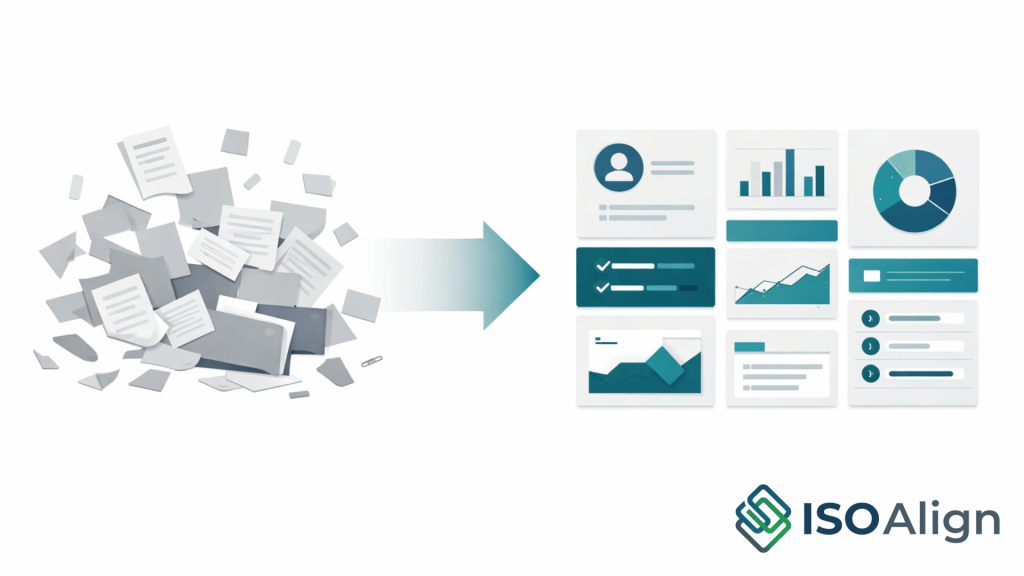
ISO Align became the platform we wished we’d had during all those consulting projects. It brings together environmental aspects, Significant Energy Users, risks, opportunities, legal obligations, objectives, audits, and actions into one structured environment where everything connects logically.
Instead of managing multiple spreadsheets, users work with integrated registers that understand the relationships between different elements of their management system. Instead of version control chaos, they get automatic change tracking and clear audit trails. Instead of lost actions and missing evidence, they get clear ownership, deadlines, and organised documentation.
Most importantly, ISO Align makes maintaining an ISO 14001 or ISO 50001 system feel like a normal part of running an organisation, not a separate compliance burden that sits awkwardly alongside real work.
Why This Matters
We built ISO Align because we believe ISO shouldn’t be harder than the work it’s meant to improve. Environmental management and energy efficiency are challenging enough without fighting against administrative chaos.
When organisations can focus on substance rather than spreadsheets, they achieve better environmental performance, more meaningful energy savings, and cleaner audit outcomes. They build systems that actually support continuous improvement instead of just documenting it.
That’s the vision behind ISO Align – making ISO 14001 and ISO 50001 management work the way it should, so organisations can focus on what really matters: reducing their environmental impact, improving their energy performance, and building genuinely sustainable operations.
If your current ISO system feels more like administrative burden than operational improvement, perhaps it’s time to try a different approach. One built by people who understand exactly what you’re dealing with.
