

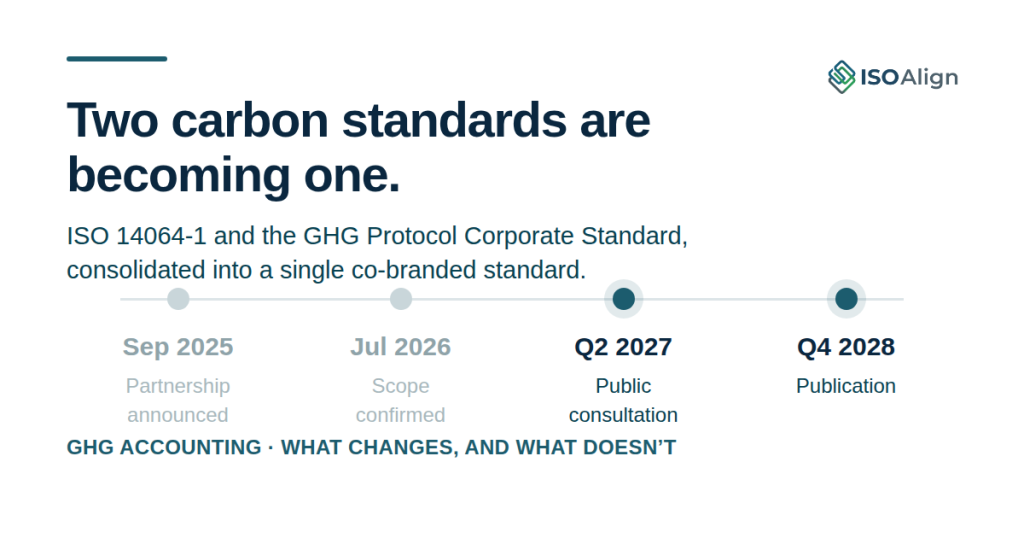

ISO 14064-1 and the GHG Protocol are being merged into a single corporate carbon accounting standard. If you report a footprint in Ireland or the UK, the useful response is not to wait for it — it is to start producing the numbers the new standard will ask for, because most of them are already visible in draft.
What has actually been announced
In September 2025, the GHG Protocol and ISO announced they would co-develop greenhouse gas accounting and reporting standards rather than maintain two parallel sets.
In late July 2026 that turned into a concrete plan. The GHG Protocol published a Standard Development Plan confirming that ISO 14064-1, the GHG Protocol Corporate Standard, the Scope 2 Guidance and the Scope 3 Standard will be consolidated into one document: the Corporate Standard version 3.0, jointly published and co-branded with ISO.
It is structured in parts. Part 1 covers general requirements and the physical greenhouse gas inventory. Part 2 covers actions and market instruments — the treatment of renewable energy purchases, credits and claimed reductions. Four technical working groups are doing the drafting, and ISO working group members joined them in the first quarter of 2026. Governance sits with an Independent Standards Board, with CDP, EFRAG, GRI, ISO, the ISSB and the SBTi holding non-voting observer seats.
Biogenic CO2 and land emissions, product life cycle standards, emission factor development and sector-specific guidance are explicitly outside this piece of work.
The two things people are getting wrong
The first is reading it as an administrative merge — two logos on one cover, no change to the numbers. That is not what the drafts say. The clearest example is the proposed multi-statement approach: physical inventory emissions, market-based emissions and the impacts of climate actions reported separately and transparently, without netting between categories. Any organisation that currently reports one figure, arrived at after applying renewable electricity certificates, will be reporting more than one figure. Same activity, different presentation, and a different conversation with the board.
The second is concluding that because publication is years away, there is nothing to do. The standard lands in Q4 2028, but the data work it implies is the slow part, and the draft proposals are public now. Collecting supplier-specific data across fifteen Scope 3 categories is a two-to-three-year exercise for most organisations. Starting it in 2029 is starting it late.
Meanwhile ISO 14064-1:2018 and the existing Corporate Standard remain in force. Nothing you report for the current financial year changes. A verification statement issued against ISO 14064-1 today does not become invalid because a successor is in development.
The dates
- September 2025 — GHG Protocol and ISO announce the partnership.
- Q1 2026 — ISO working group members join the four technical working groups.
- March 2026 — Phase 1 progress update on the Scope 3 revision published; proposals are draft and subject to change.
- Late July 2026 — consolidated Standard Development Plan published, confirming ISO 14064-1 is inside the scope.
- Q2 2027 — integrated public consultation on the consolidated draft.
- Q4 2028 — publication of the consolidated standard. Supporting guidance follows afterwards.
Adoption is a separate question again. The ISSB and the European Commission will each decide whether and when to reference the revised standard in their own requirements, so the date a reporting obligation actually moves in Ireland or the UK will trail publication rather than coincide with it.
What it means in practice
The Scope 3 proposals published in March 2026 are the ones most likely to change how much work your next inventory takes. They are drafts, and they may move. But they point clearly in one direction.
Exclusions get a hard limit. The proposal is that you report at least 95% of required Scope 3 emissions, with a maximum 5% exclusion — and that you quantify annually to demonstrate the exclusions really do fall inside it. “We don’t have data for that category” stops being a position you can hold quietly.
Data quality becomes disclosed, not assumed. Emissions would be disaggregated by data type, so a reader can see how much of your figure is supplier-specific and how much is spend-based estimation. Scope 3 would also be labelled fully verified, partially verified or not verified.
Category 15 narrows to investments, with a proposed new optional Category 16 for other value chain activities and facilitated emissions.
On the Scope 2 side, the consultation closed with nearly 1,100 responses from 56 countries and multiple reporting approaches still under consideration. This is the least settled part of the package. If your reduction story leans heavily on a green tariff or on certificates, this is the workstream to watch, because the no-netting principle and the market-based method interact directly.
There is an Irish and UK dimension worth naming. Schemes that sit on top of corporate carbon accounting inherit whatever the base standard says — the CO2 Performance Ladder now appearing in Irish public procurement, SBTi target validation, and the greenhouse gas figures inside CSRD reporting all rest on these conventions rather than defining their own. When the foundation moves, the things built on it move with it, usually a reporting cycle or two later.
What to do this quarter
- Write down which basis you actually report on. ISO 14064-1:2018, the 2004 Corporate Standard, or a working blend of both. A surprising number of organisations cannot answer this cleanly, and the answer determines how much of the consolidation touches you.
- Produce both electricity figures for the current year. Location-based and market-based, side by side, with no netting. If that is more than one line in your system today, you are already most of the way to the multi-statement format.
- Run the 5% test on Scope 3. Take a rough quantification of the categories you currently exclude. If the excluded share plausibly exceeds 5%, you know now where the next two years of data work sits.
- Tag each Scope 3 category by data type and verification status. Primary supplier data, average data, spend-based estimate — and whether anyone has verified it. This is the disaggregation the draft asks for, and it is far easier to record as you go than to reconstruct.
- Diarise the Q2 2027 consultation and decide who responds. If your sector has a data problem the drafters have not seen, the consultation is where it gets raised, not afterwards.
The short version
Two standards are becoming one, the drafting is under way, and the numbers you publish will change presentation before they change substance. The organisations that find this easy in 2028 will be the ones that spent 2026 and 2027 improving Scope 3 data quality and separating their market-based claims from their physical inventory. That work is worth doing regardless of what the final text says.
ISO Align gives sustainability, energy and IMS teams one structured place to run ISO 14001 and ISO 50001 — objectives, actions, evidence and performance data held together so the reporting basis is visible rather than reassembled each year. If you would like to see how it handles this kind of change, you can book a demo.
Sources: GHG Protocol — key standard development updates · GHG Protocol — standard development updates FAQ · Consolidated Corporate Standard — Standard Development Plan, 29 July 2026 (PDF) · Scope 3 Standard revisions — Phase 1 progress update, 31 March 2026 (PDF) · GHG Protocol — corporate suite update process · KPMG — GHG Protocol and ISO to align standards · CO2 Performance Ladder — Ireland
