
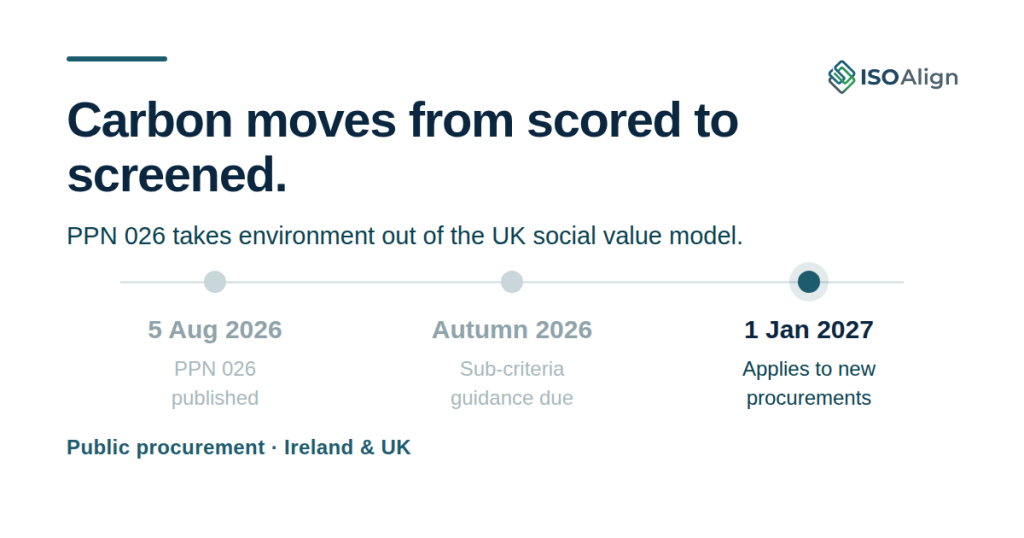

On 5 August 2026 the UK government published PPN 026, a new Social Value Model for central government procurement. The model has two outcomes: good jobs, and skills. Six criteria sit under them — job quality, working conditions, fair pay, training, in-work progression and talent pipeline.
Environment does not appear. Neither does net zero, or carbon.
It applies to procurements commenced on or after 1 January 2027, for covered procurements valued at £1m total contract value including VAT or above, across central government departments, their executive agencies and non-departmental public bodies.
If part of your tender score has been coming from your carbon commitments, that part is going.
What most people are getting wrong
The obvious reading — that net zero has been dropped from UK public procurement — is wrong, and it is the expensive kind of wrong.
PPN 026 changes the scoring model. It does not touch PPN 006. Carbon Reduction Plans remain a condition of participation for central government contracts estimated above £5 million a year including VAT, for procurements advertised on or after 24 February 2025. PPN 006 is still live and unchanged.
So carbon has not left procurement. It has moved.
It has moved out of the part of the tender where a good answer earns you marks, and it now sits almost entirely in the part where a bad answer removes you. Those are very different risks to carry. Points you can lose and still win the contract. A condition of participation you cannot.
The practical effect is that the carbon evidence most organisations have been treating as a differentiator quietly becomes a qualifier. Fewer opportunities to shine, and the same number of ways to be excluded.
The dates
United Kingdom
- 5 August 2026 — PPN 026 published.
- Autumn 2026 — detailed sub-criteria and practitioner guidance due. Not yet available.
- 1 January 2027 — PPN 026 applies to procurements commenced on or after this date. For procurements commenced under the Procurement Act 2023 before it, buyers are encouraged to move to the new model but may apply the previous edition.
- 24 February 2025 — the date from which PPN 006 applies. Unaffected by PPN 026.
Ireland — moving the other way
- 21 July 2025 — Circular 17/2025 issued, replacing Circular 20/2019. It applies to all public sector bodies.
- Above national advertising thresholds, public sector bodies are to include Green Public Procurement criteria in all tender documents, where possible, with departments reporting an explanation where they did not and national GPP criteria existed.
- During 2026 — the first GPP monitoring return is due to the EPA, covering 1 January to 31 December 2025, and annually thereafter.
- From 2026 — public bodies must include specifications for low carbon construction related components, and whole life-cycle analysis in accordance with EN 15978 is to inform the design of building projects over 1,000 m².
Read together, the two jurisdictions are pulling apart. Ireland is asking for environmental criteria in more tenders and starting to count how often they appear. The UK is taking them out of the social value score while leaving the participation gate in place.
What this means in practice
Your Carbon Reduction Plan stops being a document and starts being a gate. When carbon was scored, a thin plan cost marks. As a condition of participation, a thin plan is a yes or a no. PPN 006 is specific about what the plan contains: a commitment to net zero by 2050 for UK operations, Scope 1 and Scope 2 emissions plus a defined subset of Scope 3, the six greenhouse gases covered by the Kyoto Protocol, prepared using the GHG Protocol Corporate Standard and the UK government conversion factors, and published and clearly signposted on the supplier’s UK website. Each of those is checkable in about ten minutes by someone who is not on your side.
Bid libraries need splitting. UK social value answers built around carbon will not score against the new model from 1 January 2027. Irish GPP answers are about to be requested more often, not less. The same paragraph can no longer serve both.
The evidence underneath is identical either way. Whether a buyer scores your carbon position or screens it, they are asking the same question: do these numbers come from somewhere, and does anyone maintain them? An organisation with a working ISO 14001 or ISO 50001 system usually has that answer already — a defined boundary, a data source, a review cycle, a named owner. An organisation without one is often reconstructing figures from invoices the week before a tender closes. The difference does not show up in a scored response. It shows up under a clarification question.
What to do this quarter
- Read your own Carbon Reduction Plan the way an evaluator would. Is it actually published and signposted on your UK website, or is it a PDF someone attached to a bid in 2024? Check it against each PPN 006 element in turn. Fix the gaps now, while they are still tidy-up work rather than a pass or fail.
- Check that one number is the same everywhere. Whatever figure appears in your Carbon Reduction Plan should be the figure in your GPP tender responses and the figure your management system holds. Three versions of your Scope 1 and 2 total is a common and entirely avoidable problem.
- Split the bid library. Tag every reusable answer by jurisdiction and by where it will be assessed — selection or award. Carbon answers written for UK social value scoring need re-homing before January.
- Put the autumn 2026 PPN 026 guidance on a named person’s calendar. The sub-criteria and practitioner guidance are not out yet. Deciding how you will respond before reading them is guessing.
- If you tender to Irish public bodies, ask what they now report. Contracting authorities are reporting GPP to the EPA on an annual cycle. Knowing which criteria a buyer is being measured on tells you a great deal about what will be in their next tender.
A short close
None of this changes what a credible carbon position looks like. It changes what happens when yours is not one.
Scored criteria are forgiving. Conditions of participation are not. The organisations that will find the next eighteen months straightforward are the ones whose numbers were already maintained rather than assembled — and that is a management system question long before it is a bid question.
ISO Align is management system software for ISO 14001 and ISO 50001, built so the evidence behind your environmental and energy claims is maintained continuously rather than rebuilt for each audit, tender or report. If you would like to see how it handles the data behind a Carbon Reduction Plan or a GPP response, you can book a demo.
Sources: PPN 026: The Social Value Model (GOV.UK, published 5 August 2026) · PPN 006: Taking account of Carbon Reduction Plans in the procurement of major government contracts (GOV.UK, updated 10 July 2025) · Circular 17/2025: Updated Green Public Procurement Instructions for Public Sector Bodies (gov.ie, 21 July 2025) · Circular 17/2025 full text (PDF) · Green Public Procurement (Office of Government Procurement) · Green Public Procurement — General Guidance for the Public Sector, 4th edition (EPA)
