


The EU’s Carbon Border Adjustment Mechanism moved out of its transitional phase and into the definitive regime on 1 January 2026. Reporting is no longer the whole of it. Importers of cement, iron and steel, aluminium, fertilisers, hydrogen and electricity now need authorisation, and in time they will pay.
But nothing has to be paid yet. CBAM certificates do not go on sale until 1 February 2027, and the first annual CBAM declaration — covering imports made during 2026 — is not due until 30 September 2027.
What is happening in 2026 is quieter and more demanding than a bill. The emissions data behind those imports is being assembled and, for the first time, independently verified. That work is happening now, and for most organisations it is landing on the wrong desk.
What most people get wrong
Two things, consistently.
The first is that CBAM is a customs problem. It does arrive through customs, and authorisation and certificates are handled by an importer. But the number at the centre of it — embedded emissions per tonne of a specific good, from a named installation, on a particular production route — cannot be produced by a customs team. It comes from the plant. Which means it lands on operations, energy and environmental staff who may not have been in the room when CBAM was discussed.
The second is that if you don’t import, you’re not involved. Manufacturers in Ireland and the UK who sell cement, steel, aluminium, fertiliser or hydrogen into the EU sit on the supply side of someone else’s CBAM declaration. Their customer’s declarant needs installation-level data from them, and from 2027 will want it with a verification report attached. The request arrives as a customer email rather than a regulatory notice, which is exactly why it tends to get handled late.
The dates that bind
1 January 2026 — the definitive regime applies. Importers above the 50 tonne annual mass threshold (a cumulative, calendar-year test that excludes electricity and hydrogen) must hold, or have applied for, authorised CBAM declarant status. In Ireland the Environmental Protection Agency is the national competent authority and Revenue’s Customs Division is the customs authority.
April 2026 — national accreditation bodies began accrediting CBAM verifiers.
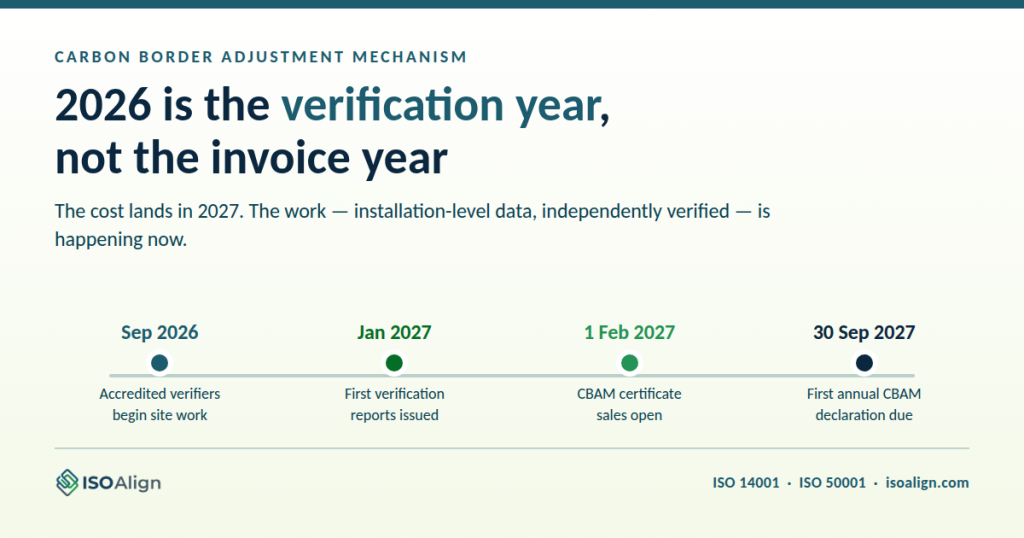
September 2026 — accredited verifiers can register and begin verification work: document review and site visits.
January 2027 — the first verification reports can be issued, and operators can pass them to their declarants.
1 February 2027 — CBAM certificate sales open. Under the omnibus amendments, the quarterly certificate-holding requirement is 50% of embedded emissions since the start of the calendar year, down from the 80% originally set.
30 September 2027 — the first annual CBAM declaration is due, covering 2026 imports. This was moved out from 31 May.
1 January 2027 — the UK’s own CBAM begins, covering aluminium, cement, fertiliser, hydrogen, and iron and steel. Registration is triggered at £50,000 of CBAM goods, tested against a rolling twelve months or against what you expect to import in the next 30 days.
Look at the shape of that sequence. Verification capacity opens in September 2026, and the reports it produces are needed for a declaration due roughly a year later. The same accredited firms also serve the EU Emissions Trading System. That is the bottleneck, and it is not a wide one.
What it means in practice
Default values are an option, and a costly one. A declarant may use default values instead of actual verified emissions, and defaults need no verification at all. That is the easy route. It is also deliberately unattractive: for countries without reliable data the defaults are set at the highest emission intensity among countries that do have it. If your real figure is better than the default — and for most modern European plant it will be — the difference is money. Either you lose it, or your customer pays it and starts asking why your competitor’s paperwork is better than yours.
The granularity is finer than a carbon footprint. A corporate inventory, even a well-built one under ISO 14064-1 or the GHG Protocol, does not answer a CBAM question. CBAM asks for the emissions embedded in a defined quantity of a defined good, from one installation, including the precursor materials that went into it. Most organisations have to disaggregate a level below anything they currently report, and that requires metering and production records that actually reconcile with each other.
The evidence test is a familiar one. Verifiers review the monitoring approach, the emissions calculation and the supporting evidence before issuing a report. Anyone who has been through an ISO 14001 or ISO 50001 audit will recognise the logic: a documented method, controlled versions, retained records, and a traceable line from a meter reading to the number that leaves the building. Organisations that already run that discipline are doing this once. Organisations that reassemble numbers for each new request are about to discover what that habit costs.
A carbon price already paid can be deducted — but only with evidence to support it. For UK producers inside the UK ETS, that is worth establishing early rather than arguing about in 2027.
What to do this quarter
- Decide which side of it you are on. Confirm whether you import CBAM goods above the 50 tonne threshold, supply them into the EU, or both. “Both” is common in Irish and UK manufacturing, and each side carries a different task.
- If you import and have not applied for authorised declarant status, apply. Applications go through the Commission’s CBAM registry. EU-established importers can generally continue importing while a decision is pending, but that only helps if the application is actually in.
- Produce one installation-level number, in full, for your highest-volume CBAM product line. Not a policy and not a plan — one number, with the method written down and the source data attached to it. Doing it once for real will find your gaps faster than any desktop assessment.
- Approach a verifier before the autumn is booked out. Capacity opens in September 2026 against a declaration due in September 2027, and the firms doing this work are the same ones already committed to EU ETS verification.
- Point the system you already have at it. The monitoring, version control and record-retention requirements CBAM verification will test are the ones ISO 14001 and ISO 50001 already impose. Use them, rather than building a parallel process that nobody maintains between requests.
The short version
CBAM’s cost lands in 2027. CBAM’s work lands in 2026. The organisations that find the first part manageable will mostly be the ones who spent this year able to say, without a scramble, where each of their numbers came from.
ISO Align is a management system platform for ISO 14001 and ISO 50001 — registers, actions, evidence and owners held in one structure, so the data behind a request like this is already controlled rather than reassembled from scratch. If that is the year you would rather have, book a demo.
Sources: CBAM definitive regime, European Commission · Verification of CBAM emissions, European Commission · EU Carbon Border Adjustment Mechanism, Environmental Protection Agency · EU adopts simplifications of CBAM rules ahead of the compliance phase starting in 2026, ICAP · Work out the date you’ll need to register for CBAM, GOV.UK · Check if you’ll need to register for CBAM, GOV.UK · Important deadline for CBAM importers, Mason Hayes & Curran
