


Two energy compliance dates land before the end of this year, and almost nobody has them in the diary — because in both Ireland and the UK the deadline everyone talks about is in December 2027.
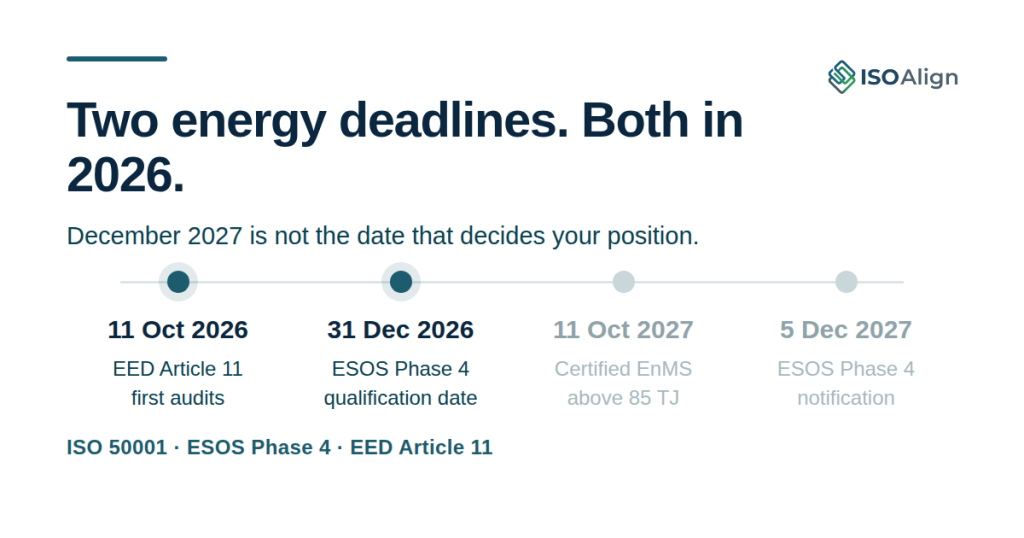
In the UK, the ESOS Phase 4 qualification date is 31 December 2026. In the EU, the first energy audit deadline under Article 11 of the recast Energy Efficiency Directive is 11 October 2026.
Neither is a submission date. Both are the dates that decide what you have to do, and how much of the following year you spend doing it.
The dates, plainly
United Kingdom — ESOS Phase 4
- 31 December 2026 — qualification date. Whether you are in or out of Phase 4 is decided on this day.
- 5 December 2027 — compliance notification deadline. The compliance period runs from 6 December 2023 to this date.
- 5 December 2028 — action plan deadline, with progress updates due in 2029 and 2030.
Ireland and the EU — Article 11, Directive (EU) 2023/1791
- 11 October 2026 — enterprises with average annual energy consumption above 10 TJ, but not above 85 TJ, are to have had an energy audit, then every four years.
- 11 October 2027 — enterprises above 85 TJ are to have an energy management system in place, certified by an independent body.
What most people get wrong
The common reading is that both regimes have a deadline in late 2027, so this is next year’s problem.
It isn’t, for a specific and slightly technical reason: the qualification date is not the date you act on. It is the date you are measured on.
Take ESOS Phase 4. Qualification turns on your size at 31 December 2026 — broadly, 250 or more employees, or turnover above £44 million together with a balance sheet total above £38 million, on the figures in the current guidance. If you cross a threshold in November 2026, you are in, and there is nothing you can do about it in 2027.
More awkwardly, the twelve-month reference period you use to measure total energy consumption must include the qualification date and must end before the compliance date. That is a data requirement pointing backwards. If your metering is patchy, or your transport fuel sits on a different account, or a site changed hands mid-year, you find out in 2027 that the twelve months you needed were the twelve months you did not measure properly.
The Article 11 date works the other way and is tighter still. The 10 TJ and 85 TJ thresholds are based on average annual consumption over the previous three years. You do not choose whether you are in scope; your last three years of consumption chose for you, and 11 October 2026 is roughly seven weeks away.
The Irish position needs a caveat
Ireland’s mandatory energy audit scheme currently runs on S.I. 426 of 2014, as amended. It defines obligated entities by size — 250 or more employees, or turnover above €50 million with a balance sheet above €43 million — requires an audit every four years covering at least 85% of total delivered energy use in the State, and accepts a certified management system, confirmed in writing by a Registered Energy Auditor, as an alternative route.
The recast Directive changes the trigger from headcount and turnover to energy consumption. That is a real change of population: a small, energy-intensive manufacturer that never qualified on size can be well above 85 TJ, and a large, low-intensity services business may fall out of scope entirely.
At the time of writing we could not confirm that Ireland’s transposing instrument for Article 11 has been published, and published commentary through 2025 noted it was still outstanding. So the honest position is: the Directive dates are fixed, the Irish detail — thresholds as applied here, notification mechanics, who confirms what — may not be settled. Confirm your own position with SEAI rather than assuming either scheme applies unchanged.
ISO 50001 is the route that does double duty
Here is the part worth sitting with.
Both regimes accept a certified energy management system in place of the audit route, and above 85 TJ the EU regime does not merely accept it — it requires it.
In ESOS, ISO 50001 certification covering at least 95% of total energy consumption removes the need for a lead assessor and substitutes for the audits. In the Irish scheme, a certified system confirmed by a Registered Energy Auditor has long been an accepted alternative. Under Article 11, above 85 TJ, an independently certified system is the obligation itself.
So an organisation operating on both islands can either run two audit exercises against two sets of rules on two timetables, or run one energy management system that answers both. That is not a certification pitch — it is a scheduling argument. The audit route is cheaper once and more expensive every four years thereafter, because each cycle starts from scratch. A management system costs more to stand up and less to keep running, because the data collection, the significant energy user analysis and the improvement actions are continuous rather than rebuilt each time.
One caution: ESOS Phase 4 tightened this route rather than loosening it. Participants using ISO 50001 are no longer exempt from calculating energy intensity ratios, and Phase 4 asks for energy consumption broken down by organisational purpose — buildings, transport, industrial processes, other. If your system reports energy by cost centre or by site, that split may not exist yet.
What to do this quarter
- Work out where you sit against the thresholds — in TJ, not in headcount. Convert your last three years of total energy consumption across every carrier, including transport fuel, to terajoules. That single number tells you whether Article 11 puts you in the 10 TJ tier, the 85 TJ tier, or neither.
- Check what your twelve-month ESOS reference period will look like. It has to include 31 December 2026. Identify now which meters, accounts and sites are missing or unreliable, while there is still time for the period to be a good one.
- Decide the route before you need it — audits or a management system. If you have UK and Irish operations, or you expect to be above 85 TJ, do the arithmetic on both paths across the next four years rather than the next twelve months.
- If you already hold ISO 50001, test it against the Phase 4 additions. Energy intensity ratios and the breakdown by purpose are the two most likely gaps, and both are reporting changes rather than system changes.
- Confirm the Irish detail with SEAI before building a plan on assumptions about which scheme applies to you and when.
The point
Two deadlines in December 2027 make this look like a 2027 exercise. It isn’t. The dates that determine scope, data quality and cost all fall in the next four months, and by the time the 2027 deadlines are close, the decisions have already been made for you by whatever your metering happened to record.
Nothing here needs a large project. It needs an afternoon with your consumption data, a clear view of which threshold you sit above, and a decision about which route you want to be on before the choice narrows.
ISO Align is a digital management system for ISO 14001 and ISO 50001 — registers, actions, evidence, audits and reviews held in one connected structure, so the data these schemes ask for is already there rather than reassembled each cycle. If a deadline like this is on your desk, book a walkthrough.
Sources: How to comply with the Energy Savings Opportunity Scheme (ESOS) Phase 4, GOV.UK; Directive (EU) 2023/1791 on energy efficiency, EUR-Lex; Commission Recommendation (EU) 2024/2002 on transposing Articles 8 and 11; SEAI Energy Auditing Compliance Scheme; Arthur Cox, Energy management systems and energy audits: new rules under the recast Energy Efficiency Directive.
