

ISO 14001:2026 is published. ISO 14001:2015 is withdrawn. And almost every conversation we have about it starts in the same place: we have until 2029, so it’s not urgent yet.
That’s the wrong date to plan around.
The dates that actually constrain you
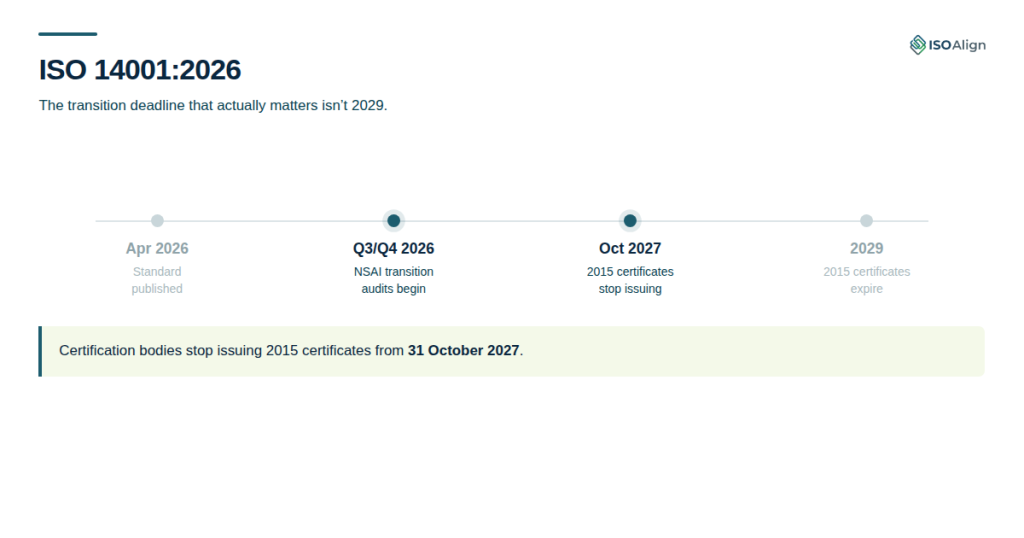
The 2029 figure is real, but it’s the end of the runway rather than the point at which your options narrow. The constraints arrive considerably earlier:
- Q3/Q4 2026 — NSAI has indicated transition audits begin this quarter.
- 31 October 2027 — UKAS has confirmed certification bodies must stop issuing certificates to the 2015 version from this date.
- April 2029 — remaining 2015 certificates cease to be valid.
There is also a step most transition guidance skips over: certification bodies have to complete their own transition before they can transition anyone else. Their assessors need requalifying, their procedures updating, their accreditation confirming. That work happens through 2026 and 2027, and it compresses the window in which audit capacity is actually available.
Ireland is a small market with a finite number of accredited bodies. If a meaningful share of certified organisations leaves this until 2028, the queue forms in front of the same handful of auditors.
Count your surveillance visits, not your years
Here is the more useful way to think about timing.
Most certificates run on a three-year cycle: an initial or recertification audit, then two surveillance visits. Transitions are normally handled at a scheduled visit rather than as a separate exercise, because that is cheaper and less disruptive.
So the question is not “how many years do I have?” but “how many audit visits do I have left before late 2027?”
For most organisations the answer is one or two. That is your real planning window — and if you want the transition handled at a routine surveillance visit rather than as an unplanned extra audit, the gap analysis needs doing well before the visit, not during it.
The changes that take real work
If ISO 14001:2026 were a tidy-up, none of this would matter much. It isn’t.
Climate change, properly integrated
Climate considerations are now woven into the standard rather than appended to it. For organisations whose environmental management system has treated climate as a reporting exercise sitting alongside the system, this means bringing it inside — into context, into risks and opportunities, into objectives.
Value-chain impacts
This is the significant one. The 2026 edition extends environmental impact thinking upstream and downstream across the value chain, with a lifecycle perspective that goes beyond what most organisations have documented.
An environmental management system that has only ever assessed aspects and impacts inside the site boundary now needs a defensible view of impacts beyond it. That is the same territory as Scope 3 emissions. It is also the same territory the CO2 Performance Ladder asks about when carbon performance is scored on Irish public frameworks.
If you are already doing carbon accounting, that work is not separate from your transition — it is a substantial part of it. If you are not, the transition has just given you a reason to start.
Change management
There is a new explicit requirement around planning and controlling changes to the system. In practice this means being able to show what changed, who approved it, and what was considered — which is straightforward if your system records changes as they happen, and painful to reconstruct if it does not.
Do it once, not twice
One scheduling point worth acting on: ISO 9001:2026 is due in September 2026.
Most Irish and UK organisations running ISO 14001 also run ISO 9001, usually as an integrated management system. Two revisions built on the Harmonized Structure, landing five months apart, is either an expensive coincidence or an opportunity, depending on how you sequence it.
Handled together, you do one gap analysis, one documentation review and one integrated transition audit. Handled separately, you do all of it twice and pay for two audit visits. That decision needs making now, while both are still ahead of you — not in 2027 when one is already done.
What to do this quarter
- Check your certificate. Find your next two audit dates and mark them against October 2027. That tells you which visit carries your transition.
- Ask your certification body when they expect to be ready to transition clients, and whether they will handle ISO 14001 and ISO 9001 together.
- Run a gap analysis against the 2026 text, focusing on the three areas above rather than the whole standard. Most of your existing system carries over unchanged.
- Start the value-chain work now. It is the longest lead-time item, it needs data from suppliers and customers, and it is the piece you cannot complete in the weeks before an audit.
The point
None of this is a crisis. ISO 14001:2026 is a sensible revision and most well-run systems will transition without drama.
But “we have until 2029” quietly converts a manageable two-year piece of work into a rushed one, because it points at the wrong date. The pressure point is 2027, the value-chain clause is the part that takes longest, and the cheapest version of this transition is the one planned around an audit visit you already have booked.
Worth an hour in the diary this quarter rather than next.
ISO Align is a digital management system for ISO 14001 and ISO 50001 — registers, actions, evidence, audits and reviews in one connected structure, so maintaining the system is normal management rather than a seasonal emergency. If you are planning a transition, book a walkthrough.
Sources: UKAS technical bulletin on the ISO 14001:2026 transition; NSAI transition guidance; ISO/TC 176/SC 2 announcement on ISO 9001:2026.
